
Epoxy Flooring Terms & Definitions
Common terms we use in the industrial and commercial epoxy flooring business.
We tend to throw around a lot of industry lingo in our work and on our website, so here’s a quick breakdown of some common terms we use when installing epoxy floors in industrial and commercial spaces.
Cove Base
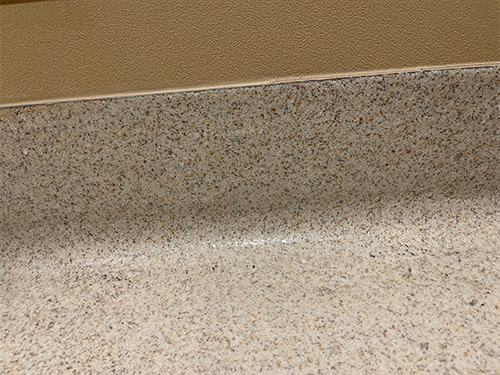
As it applies to resinous flooring, integral cove base is essentially a continuation of the floor up the bottom few inches of a wall. Made from the same material as the floor, cove base is troweled up the wall to a fixed height, usually 4-6” and provides a seamless connection between the floor and bottom portion of the wall. At the transition between floor and wall, there is a radiused portion, basically a rounded corner. This curved, seamless transition prevents dirt, debris, and moisture from collecting in what would otherwise be a 90-degree corner. Cove base generally protects walls and provides better cleanability in spaces that are wet or need frequent cleaning.
Resinous Flooring
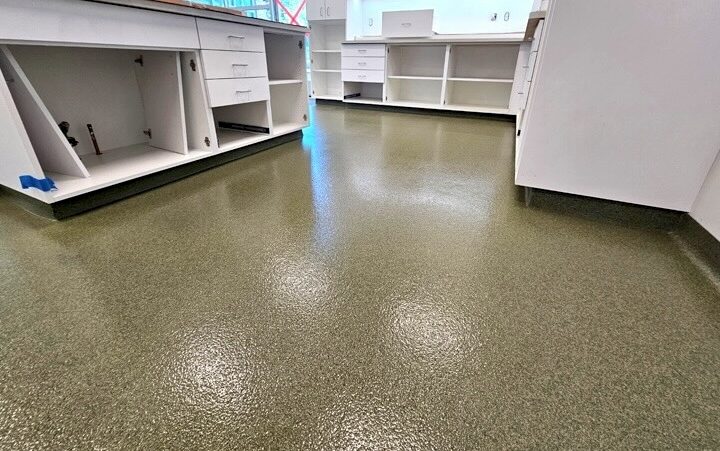
In technical terms, resinous flooring is any flooring system where multiple layers of synthetic liquid polymers are poured directly over a prepared concrete slab. But the best way to think of it is as an umbrella term for all the flooring systems we install. This includes epoxy, polyaspartic, urethane, urethane cements, polyurea, methyl methacrylate and other materials. Most people refer to all of these as epoxy flooring, but technically epoxy is just one type of resinous flooring.
The technical terminology doesn’t matter. If you call us asking for an epoxy floor, we’ll have a conversation about your needs to make sure we choose the right materials and system design for your space.
Flooring Profile
Profile means the height of the peaks and valleys in an epoxy floor. Through the broadcast of different aggregates as well as the amount of coating over those aggregates, a resinous floor can achieve a profile anywhere from completely smooth all the way up to very rough. The aggregates are almost always coated so that they are not exposed and therefore are less rough and more easily cleanable. However, in certain circumstances roughness and sharpness is desired for maximum non-skid properties. Typically resinous floor profiles fall somewhere between smooth and an “orange peel” like texture, however a knowledgeable installer can make a resinous floor profile however you like it.

Aggregate
Aggregates are the tiny pieces of rock, stone, minerals, mica, or vinyl that are mixed into epoxy and other resinous flooring. Their purpose can be functional (like creating a durable, non-slip surface), decorative (like adding colorful speckles), or both. Different aggregates can be broadcast into various resinous flooring materials to achieve various desired results.
Common Aggregates and Their Uses
Clear quartz (think playground sand at various grit sizes) can be used to thicken materials and add strength and durability. Meanwhile colored quartz can be used to produce an infinite number of color combinations, often resembling a carpet in appearance. Vinyl flake is another decorative aggregate with infinite color combinations and a variety of sizes to create decorative resinous floors.
Broadcasts
A broadcast is the process of throwing/scattering aggregate into wet resinous material. There are many reasons to add aggregate to a resinous floor, but typically it is either to add strength and durability and/or to produce a decorative floor.
Number of broadcasts
Multiple broadcasts may be needed to get the desired outcome. A single broadcast can sometimes be used on a low cost floor when applied over a tinted base coat, however most commercial and industrial grade floors call for a double broadcast “to rejection” to make sure the floor is fully and evenly covered with the aggregate and has the best appearance.

Concrete Slab
A concrete slab is the functional floor of an industrial or commercial space. It’s typically 6-12” thick, reinforced with rebar or other metal fibers to prevent cracking. Epoxy flooring is almost always installed directly onto a prepared concrete slab. “Prepared” means we have cleaned, repaired, and textured the surface so the coating can grip the slab. A prepared concrete slab provides the appropriate surface to allow the resinous flooring to bond to the floor without flexing.
It is a surprise to many to learn that epoxy is not flexible – it is extremely rigid. While it has plenty of strength and durability when well bonded to a concrete slab, it does not have significant flexural strength. For this reason, it’s always desirable to have a prepared concrete slab for epoxy installations and we advise against installing resinous flooring on top of plywood or other materials that may have any flex to them.
ESD
ESD is short for Electrostatic Discharge flooring. This is a special category of flooring that protects sensitive components from the damage that could come from a static shock. It works by drawing away the static charge that builds up from everyday activities (like walking on it) and redirecting that charge to the building’s electrical ground.
There are two broad categories of ESD flooring, electrostatic dissipative and electrostatic conductive. One is effectively a more heavy duty version of the other. Conductive is used in critical environments, like explosive facilities where a static spark could have truly horrible consequences. Dissipative floors are not quite as significant in their design and build. They still offer protection against static shock, but to a lesser extent than their conductive counterparts.
Flooring Expertise
This is the deep knowledge that comes with over 30 years of hands-on experience installing floors for Colorado businesses. We’ve installed every variety of resinous flooring for just about every type of business. We understand the needs of the general contractors and businesses we work with and we partner with our clients to make sure we install a flooring solution that does the job it was intended to do and looks good doing it.
If you’re looking for a flooring contractor who knows their terminology, so you don’t have to, give us a call. We have a proven track record of helping our clients make informed flooring decisions that save time and money in the long run.
(303) 762-1600