Epoxy Top Coats And Their Uses
Every layer of an epoxy flooring system has a purpose, but the top coat can make or break a floor.
Epoxy flooring systems, or more broadly resinous flooring systems, are usually built with a number of layers followed by a top coat. Every layer in a resinous flooring system has a specific purpose, but the top coat can take on additional responsibilities.
Before we dive into epoxy top coats, it makes sense to explain how an epoxy flooring system is constructed, and why the number of layers matters.
Epoxy Flooring Layers
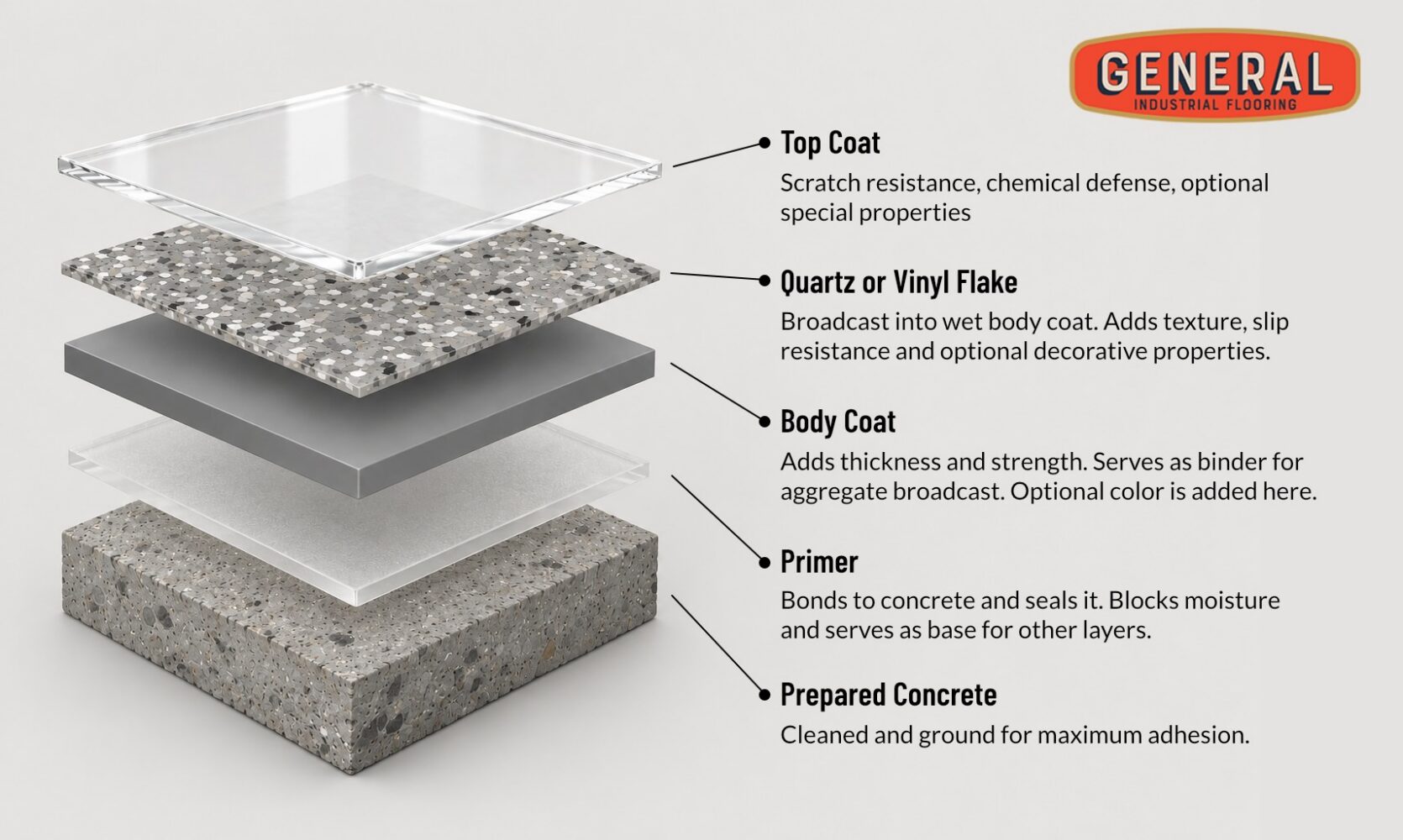
Concrete Slab
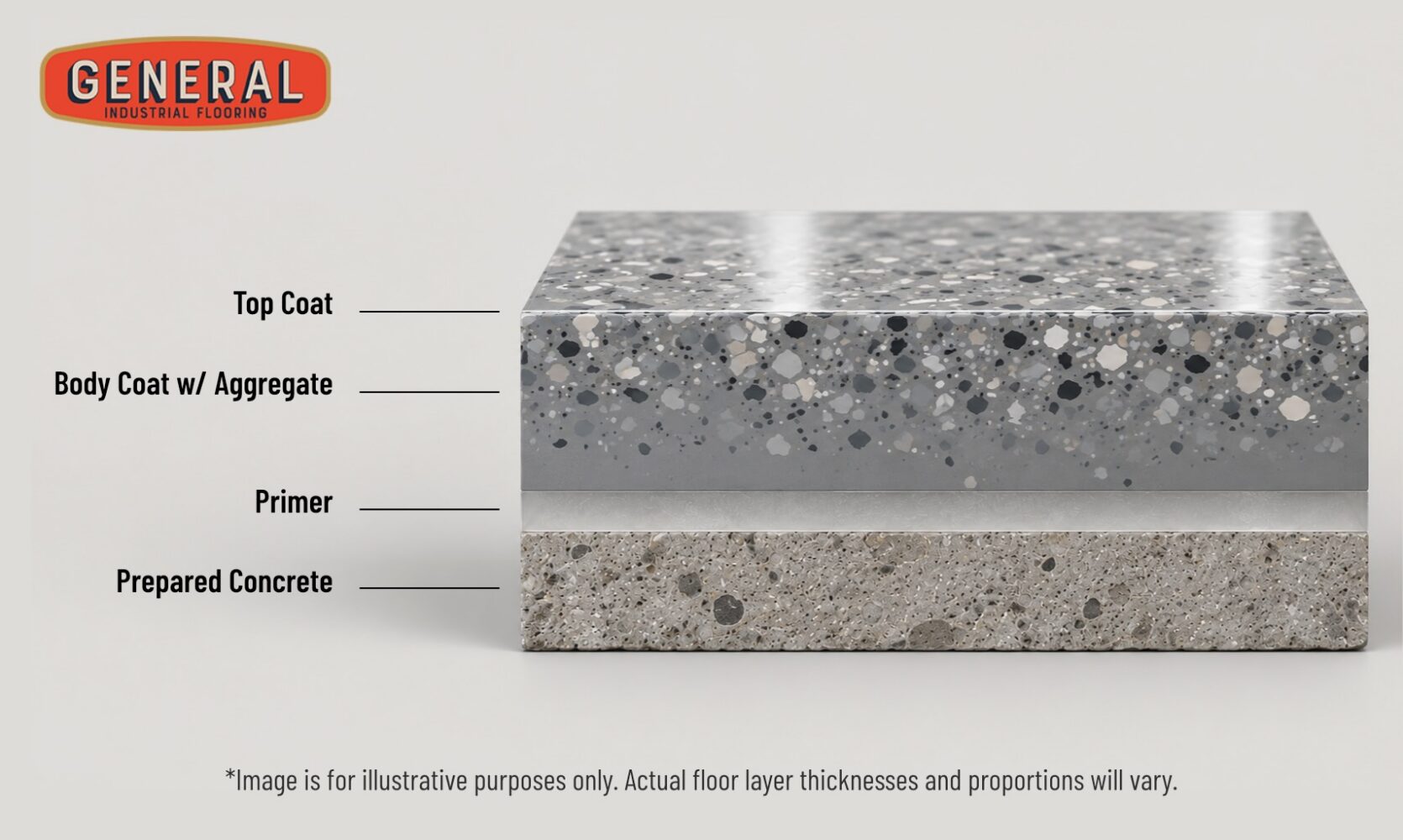
In commercial and industrial spaces, the concrete slab is the structural foundation of the building and also the primary ground-floor surface. Concrete can be ground, sealed, and/or polished as a finishing method, depending on the purpose of the space. Epoxy floors and other resinous flooring are installed directly on top of the prepared concrete slab, bonding to it.
Primer
The primer is the layer that bonds to the concrete slab and lays the foundation for every layer that will go on top of it. A primer can have specific functions, like a moisture vapor primer, which blocks moisture from the slab and ground below. A primer can prevent bubbles from impacting later layers. It can also build a durable and shock absorptive base like in the case of urethane cement.
Body Coat
The second layer is called a body coat. This coat adds thickness and strength to the system.
Aggregate
The body coat also serves as a binder coat to receive any aggregate, like quartz sand or vinyl flake. These aggregates are broadcast (scattered) onto the floor while the body coat is still wet. They serve to add durability and thickness to the floor or to add a decorative quality to the floor with colored quartz, vinyl chips or even a metallic epoxy.
Multiple Body Coats
Depending on the needs of the space, there can often be more than one body coat applied. Typically a body coat is composed of a relatively generic 100% solids epoxy. Since it will ultimately be covered by the top coat, it usually doesn’t make sense to put highly expensive material into a body coat.
Top Coat
Now on to top coats. The top coat is arguably the most important coat in a system because it is going to receive all the direct wear. That could mean chemical spills, boiling water spills, exposure to hot ovens or equipment, heavy cleaning, forklift traffic, etc. It’s absolutely essential that the top coat is properly selected for the floor that will be installed, to do the job it needs to do, correctly.
Types of Epoxy Top Coats
Hardened Epoxy Top Coat
A hardened epoxy top coat is a heavier duty epoxy than what is typically found in the body coats of a flooring system. It is designed to receive more wear and thus needs to be more durable. It’s also typically more chemical resistant than epoxy body coats. While this is a good general option that is also available at a lower price point, it does have the potential to amber when exposed to ongoing sunlight, so that is something to consider in environments where that slight color change could be more obvious.
Polyaspartic Top Coat
A polyaspartic top coat performs similarly to a hardened epoxy top coat, however it tends to have more chemical resistance and typically does not amber like epoxy does. It can be harder to work with on large jobs since it has a faster pot life / dry time. For this reason, it’s typically not advised for large surface areas (xxxx + sq. ft.), since it can lead to a less consistent appearance on the floor.
The fast dry time of polyaspartic can be a major benefit on smaller jobs (up to xxxx sq. ft). An installer may be able to apply multiple coats in the same day which isn’t usually doable with epoxy. The downside to polyaspartic (at least quality polyaspartic products) is that they are substantially more expensive than epoxy, typically twice as much.
Urethane Top Coat
Not to be confused with Urethane Cement, which is an entirely different resinous flooring product, urethane is a thin mil coating top coat. Despite being a thin coating, it is durable and has good resistance against scratching and lateral skidding. Urethane also provides substantial chemical resistance for things like hot water washdowns, and exposure to solvents, moderate cleaners, and oils. Though it is not the most chemical resistant coating available (see Novolac below), it is reasonably low cost.
A urethane top coat can also be useful in making a clear “sealer” coat over ground concrete, usually when coupled with a clear epoxy primer coat. For those that want a sealed concrete or polished concrete look along with the durability and cleanability of a resinous coating, this is a good option. Lastly, urethane is often used in ESD (electrostatic discharge) floors, often combined with powders to give it those ESD properties.
Novolac Top Coats
Novolac is almost exclusively used when strong chemical resistance is required. This, very expensive, specialty top coat provides excellent resistance to chemicals, especially acids, making it appropriate for chemical processing and manufacturing facilities.
Novolac is a hard and durable coating as well. It is often limited in color selection, however, and can be hard to find in clear, for example.

Hybrid Top Coats
Some manufacturers make hybrid material top coats. One example would be Accelera, made by Sherwin Williams Industrial. This excellent product is a fast-curing, high-performance polyaspartic/polymer topcoat and resin system. As a top coat, it provides great durability and high chemical resistance, especially alkaline chemicals and solvents, making it a great choice for biotech and healthcare facilities.
Why Selecting The Right Top Coat Matters
Many installers seem to follow the old adage of “If your only tool is a hammer, everything looks like a nail”. That is, when it comes to system design and top coat selection, they use the same thing every time, regardless of the needs of the space. A knowledgeable contractor knows there is a very wide selection of materials available to meet the needs of the client.
If you are unsure about which top coat, or flooring system for that matter, is best for your space, trust the experts at General Industrial Flooring. Call us and we talk through your needs and options. We’ll design a flooring system and the right top coat(s) for your specific use case.
(303) 762-1600